The grill sizzled steadily, sending thin ribbons of smoke into the warm afternoon air as the quiet suburban backyard filled with familiar sounds. Lawn chairs pressed into uneven grass, and the low murmur of conversation drifted between men whose hair had gone gray but whose posture still hinted at old habits of discipline. I hadn’t been home in nearly a year, and the distance felt heavier than my travel bag.
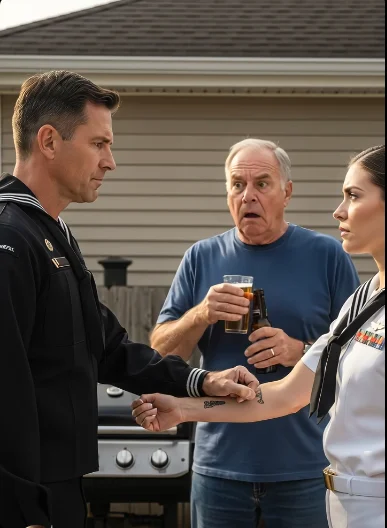
I had arrived straight from a formal ceremony in Washington, still wearing my Navy dress whites because I hadn’t had the energy—or the patience—to change. The uniform stood out awkwardly at a casual barbecue, but exhaustion overruled self-consciousness. Sunlight reflected off the insignia on my chest, catching more attention than I intended.
My father spotted me first. His face lit up with a practiced smile, beer in hand, confidence masking years of unspoken assumptions. He raised his voice so the group could hear. “Our little clerk is home,” he announced cheerfully, as if the words were harmless and familiar.
There was polite laughter, the kind people use when they sense discomfort but don’t want to acknowledge it. Several men turned to look at me, curiosity mixed with casual judgment. My father walked over and gave me a quick, one-armed hug before turning back to his friends.
“This is my daughter, Alex,” he said. “She’s Navy. Does paperwork and coordination. Smart stuff.”
One man nodded and asked if I worked in logistics. I corrected him gently. “Intelligence. Special operations.” The words landed lightly, but no one lingered on them.
Then another man stepped forward, his posture sharp, his eyes alert in a way that couldn’t be taught. He introduced himself as Commander Jacob Reins. The respect in his voice was natural, not forced. We exchanged brief pleasantries before drifting closer to the grill with the others.
Conversation returned to safe topics—sports, weather, memories softened by time. I stood at the edge of the group, smiling when expected, counting minutes until leaving would be polite. That was when Reins noticed my left forearm, where the sleeve of my uniform didn’t quite reach.
The small tattoo there caught his attention immediately.
He stopped mid-sentence, eyes narrowing slightly as recognition settled in. “Unit Seventy-Seven,” he said quietly.
I nodded. The air around us seemed to pause.
“What’s Unit Seventy-Seven?” my father asked, confused.
Reins straightened instinctively, his tone shifting to formal precision. “Rear Admiral Callahan,” he said, addressing me directly. “Ma’am. It’s an honor.”
The backyard fell into a stunned silence. My father stared at me, disbelief flickering across his face as the realization slowly took shape. He looked at my insignia, then back at Reins, searching for confirmation.
“You’re… an admiral?” he asked.
“Yes,” Reins replied calmly. “Two-star.”
My father’s expression collapsed into something quieter and far more vulnerable. He struggled to speak, eventually managing, “You said you did coordination.”
“I do,” I replied. “And command.”
The barbecue never recovered its rhythm. Guests made polite excuses and left early, the energy draining from the yard. Reins lingered briefly, apologizing for nothing he had done wrong, before departing with a respectful nod.
Inside the house, the kitchen looked exactly as it had when I was a child. My father sat at the table, hands folded, voice uncharacteristically soft. “I didn’t know,” he said.
“You didn’t ask,” I answered.
The truth stung, but it needed to be said. After a long pause, he admitted quietly, “I was wrong.”
Later, sitting on the front steps, we watched the sun dip behind familiar rooftops. When he apologized again, this time with specificity, I asked for time. He nodded, understanding at last that some repairs couldn’t be rushed.
Growing up, I learned discipline, precision, and the value of competence from my father. I also learned how easily love can become conditional without intention. I joined the Navy determined to prove myself, moving steadily through ranks, responsibilities, and sacrifices that rarely fit into simple explanations.
For years, my father introduced me as his “Navy girl” who handled details. It wasn’t malice—it was limitation. But limits, even unintentional ones, still shape lives.
Eventually, he began to change. He showed up. He listened. When asked what his daughter did, he stopped minimizing. He said “admiral” without hesitation.
Before his passing, we shared quieter moments—no uniforms, no titles, just honesty. He never fully caught up with the woman I had become, but he tried. That mattered.
At his funeral, surrounded by formality and memory, I felt no bitterness. Only clarity. Repair, I learned, doesn’t erase the past, but it does allow space to move forward unburdened.
People still misjudge me. They introduce me incorrectly, assume roles that feel smaller than the truth. I correct them when it matters and let it go when it doesn’t.
Because I know who I am.
I am not who someone introduces me as. I am who I have earned the discipline to be, even when no one is watching.
And that is enough.