My name is Major Molly Martin. I am thirty-five years old, Army intelligence. Yesterday, I buried my husband, Staff Sergeant Marcus Coleman, the only person who ever truly understood the woman beneath the uniform. Twenty-four hours after the folded flag was pressed into my hands, I returned home expecting silence and grief. What I found instead was an invasion.
The front door stood slightly open. My key no longer fit the lock. That was the first warning. I rang the bell once. The cheerful chime echoed through the house like mockery. The door opened to reveal my brother-in-law Timothy, shirtless, chewing chips, staring at me as if I were an inconvenience.
“Oh. You,” he muttered, stepping aside.
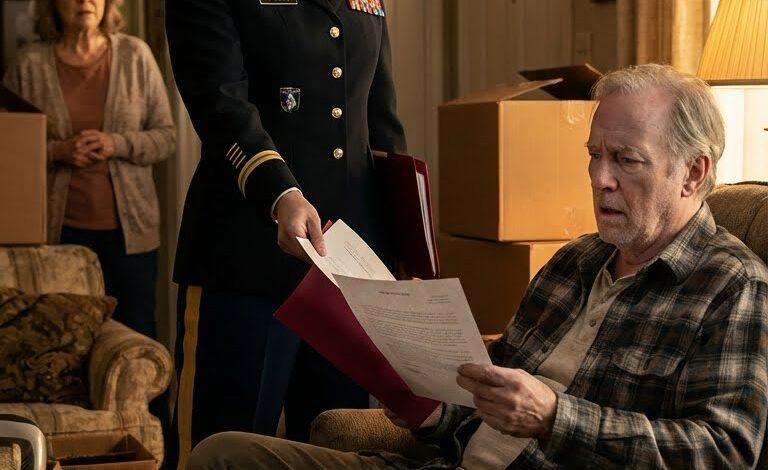
Inside, my living room had been transformed into chaos. Cardboard boxes lined the walls. My belongings were being removed as if I no longer existed. My father-in-law Raymond stood in the center holding a clipboard, directing movers with crisp authority. He did not even look at me.
“You’re back earlier than expected,” he said. “We’re moving forward with the transfer.”
Transfer. As if my home were equipment.
My mother-in-law Patricia descended the stairs holding my jewelry box. She opened it, unimpressed. “These are rather plain,” she said. “You may keep them.”
She removed our wedding photograph from the mantle, slid my image out, and dropped it into the trash. “Marcus doesn’t need distractions,” she added.
When her gaze landed on my military medals, she waved dismissively. “Gerald, take those down. They clash with the decor.”
Raymond finally faced me. “Marcus married you, but blood determines legacy. This house stays in the family. You have two hours to collect your things.”
Grief vanished. Training took over. A soldier does not react emotionally to an ambush. She assesses.
I did not argue. I did not plead. I watched. They mistook my silence for surrender. In reality, I was gathering intelligence.
I watched them remove furniture. I watched them handle my awards without care. I watched Patricia roam my home like a buyer inspecting property. And I watched Raymond, convinced of victory, dismantle my life.
What they failed to understand was simple. Marcus had anticipated this.
Three months before his death, at a family wedding, I overheard a conversation on the veranda. Raymond spoke quietly. “When Marcus is gone, we move quickly. Pressure will make her leave.”
Gerald added, “The clinic is the real asset.”
Patricia smiled sweetly. “I know exactly how to handle her.”
That night, I told Marcus everything. He did not seem surprised. He opened a leather case I had never seen.
“Joint tenancy,” he said. “Everything transfers to you.”
“An ironclad will.”
“And this,” he added, handing me an envelope, “is insurance.”
Six weeks later, cancer took him faster than expected. But not faster than his planning.
Which is why, standing in the driveway, I blocked their moving truck.
Raymond stormed toward me. “Move, or we call the police.”
A black BMW pulled up. A tall man in a charcoal suit stepped out.
“Raymond Coleman?” he asked calmly.
“I’m Charles Peyton,” the man said. “Estate attorney for Marcus Coleman.”
Color drained from their faces.
“You are committing trespass and theft,” Charles continued. “Return everything immediately.”
Inside, he opened his briefcase. “Joint tenancy. Sole ownership. No-contest clause.”
Patricia tried to speak. Charles silenced her.
Then he opened the final envelope.
Marcus’s letter cataloged every insult, every dismissal, every attempt to erase me. It ended with one sentence.
“Leave her house.”
They returned everything. Furniture. Boxes. Even the photo. My medals were rehung, untouched.
By sunset, they were gone.
The house felt different afterward. Not empty. Secure.
I later learned their reputation collapsed overnight. I returned the apology check they sent. Uncashed.
I transformed Marcus’s clinic into a memorial hospital and founded a fund for veterans’ families.
Months later, I found a final letter.
“Turn our fortress into a lighthouse,” Marcus wrote.
This morning, I watched the sun rise over Charleston. I held the line.
And now, I carry the mission forward.