My sergeant screamed for me to walk away, but it was already too late.
On the floor of the closet sat a high-end baby monitor, its speaker playing a child’s recorded voice over and over again. The sound echoed softly against the walls, unsettling in its repetition. Behind it, taped neatly to the back wall, was a large city map. Red circles marked every crime scene we had investigated that month. Every missing person. Every unresolved case. I froze, my mind struggling to process what I was seeing.
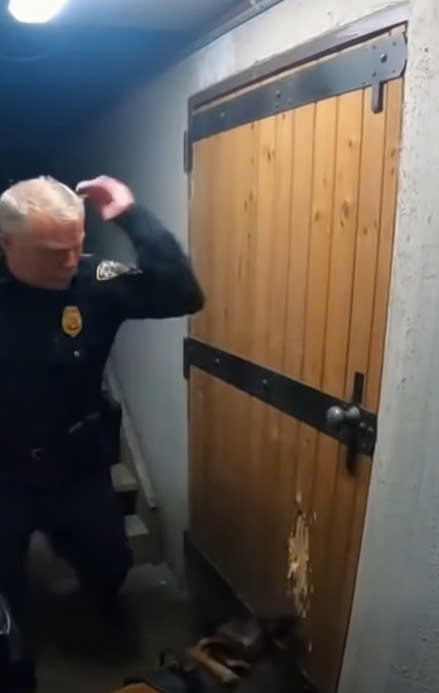
Then I felt it. The unmistakable pressure of a firearm against the back of my head.
“I told you to stay in the car, Todd,” Miller whispered calmly. “But since you’re here, take a closer look at the signature on the map.”
My flashlight drifted to the bottom corner. My legs nearly gave out when I read the name written there in thick, uneven letters: Detective Sergeant Miller.
My breathing turned shallow. The beam in my hand trembled as the truth burned itself into my thoughts. That handwriting wasn’t a coincidence. It wasn’t a shared surname. It was his. Every mark on that map had been placed by him. Every location. Every tragedy. Carefully documented.
“You did all of this?” I asked, my voice barely steady, unable to turn with the cold metal still pressed to my skull.
“Not exactly,” he replied evenly. “I was above it.”
Instinct took over. I twisted hard, slamming my elbow backward. The impact knocked the weapon loose. It hit the floor, and I lunged, grabbing it before he could react. Miller stepped back slowly, raising his hands as if this were nothing more than an inconvenient misunderstanding.
“Easy,” he said. “You don’t know what you’re doing.”
“Don’t I?” I shot back, keeping the gun trained on him. “That recording. You used it. You brought me here on purpose.”
He smiled, almost amused. “I didn’t trick you. I tested you. And you passed.”
I edged toward the door, heart racing. “I should call this in.”
“You could,” he said. “But you won’t.”
Behind him, I noticed movement in the unfinished wall. A narrow gap, hidden in shadow.
“What’s back there?” I demanded.
“You’re not ready for that,” he said quietly.
I fired a warning shot into the drywall near his shoulder. The sound rang through the house. He flinched.
“Fine,” he muttered. “You want answers? Follow me.”
He led the way toward the back of the house, stopping at a pantry door that concealed a narrow staircase. The air changed immediately. A heavy, chemical smell mixed with something older, something that made my stomach tighten.
I should have stopped him. I should have secured the scene. But I followed.
The basement was cramped and dim, lit only by my flashlight and a flickering bulb overhead. The walls were covered with newspaper clippings, missing persons flyers, and police reports. Our reports. Surveillance photos were pinned among them. Officers I knew. Some no longer around.
At the center of the room stood a steel examination table.
On it was a child-sized mannequin, marked with old stains and tape residue. Its face was painted stiffly, like a performance prop. I recoiled.
“That’s not real,” I said.
“No,” Miller agreed. “But it represents what happened.”
I turned the gun back on him. “Why show me this?”
“Because I want out,” he said. “This started as a way to remove threats the system refused to address. Then it grew. Others joined. Took it further than it should have gone.”
“Why not come forward?”
“Who would believe me?” he asked. “I needed you to see it.”
He handed me a thick file. Inside were emails, photographs, and internal documents. Corruption ran through city leadership, courts, and law enforcement. The scope was overwhelming.
“If this disappears with me,” he said, “nothing changes. But if you expose it, everything does.”
I lowered the gun slowly.
Outside, the storm had passed. I disabled the signal jammer and made one call. Not to local channels. To the FBI.
When my contact arrived, we searched the house together.
Miller was gone.
But the evidence remained.
A small recorder blinked red. I pressed play.
“I know you’ll hear this,” Miller’s voice said calmly. “Do what you believe is right. Either bring it all into the light, or walk away. But if you walk away, don’t turn back.”
The message ended.
We released everything. Secure channels. Media outlets. Federal oversight. The fallout was immediate. Resignations. Arrests. Investigations. The system shook itself apart.
Some called us heroes. Others called us traitors.
Miller was never found.
But the work didn’t end. New leads surfaced. New rooms were discovered. More names connected.
Now we know where to look.
And we never walk away.