The air that autumn carried a damp, heavy chill when my husband, Viktor, brought his mother to our small apartment. She looked nothing like the woman I had known before. Her body was thinner, her movements slow and uncertain, as if each step required careful negotiation with her own strength. Her voice had faded into a fragile whisper, and the diagnosis from the doctors was devastatingly clear. It was late-stage cancer, and the time left to her was measured not in years, but in months, possibly weeks.
That very evening, while the weight of those words still hung in the room, Viktor made an announcement that changed everything. He told me he had been assigned to a long-term business trip abroad, nearly a year in duration. He described it as a crucial opportunity, one that would secure our future and advance his career. He kissed his mother’s forehead, told her everything would be fine, and turned to me with a practiced confidence. He said I was strong, that I could handle things, and that he would send money when possible. Two days later, he left, and I was alone with his dying mother.
From that moment on, my life no longer belonged to me. My days started before sunrise and ended long after midnight. I became a caregiver in every sense of the word. I washed her, changed her bedding, prepared her medicine, and monitored her pain with the precision of someone who could not afford mistakes. I learned to recognize every sign of discomfort, every quiet signal that she needed help. I fed her with a spoon when her hands could no longer cooperate, and I stayed beside her bed at night, sleeping lightly, always listening for changes in her breathing.
Viktor’s promises of support quickly lost their meaning. The money he sent arrived irregularly and was never enough. Medication was expensive, and comfort came at a high cost. My savings disappeared one bill at a time. I borrowed money from friends, accepted late-night freelance work, and pushed myself far beyond exhaustion. I could not abandon her, even when the loneliness became overwhelming. Her own son had chosen distance and excuses, while I stayed and carried the weight of responsibility every single day.
As time passed, my mother-in-law, Elena, grew quieter but more aware. In her final days, her pain softened, replaced by a clarity that felt almost urgent. One evening, as the light faded from the window, she reached for my hand. Her grip was weak, yet purposeful. She leaned close and whispered words I did not fully understand at the time. She told me to go to her village, to dig in the cellar beneath the potato box, and not to tell Viktor.
She passed away peacefully a few days later. The funeral was subdued and lonely. Viktor did not return, claiming his contract prevented him from leaving. Instead, he sent flowers and messages of regret. Standing there alone, I finally understood the difference between obligation and love, and how easily one can replace the other.
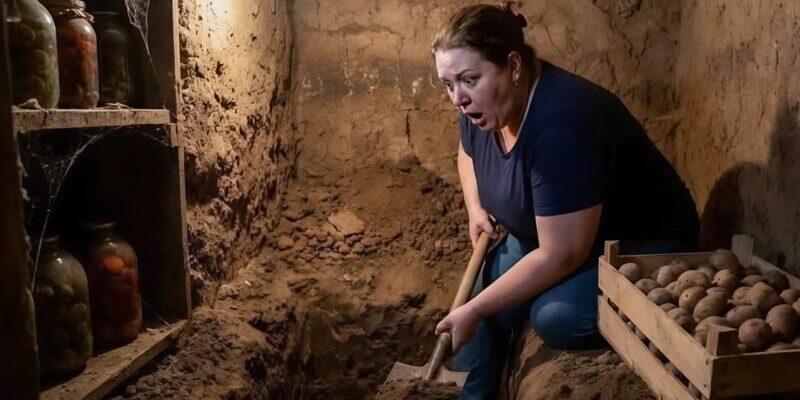
Elena’s final words stayed with me. A week after the funeral, I traveled to the village she had mentioned. Her old cottage was silent, filled with memories and dust. I went down into the cellar, located the wooden potato box, and began digging. When my shovel struck metal, my heart raced. Beneath the soil was a heavy box, rusted with age. Inside were stacks of money, gold jewelry, and legal documents. On top lay an envelope with my name written carefully in her handwriting.
Sitting on the cellar floor, I read her letter. Elena explained that she had saved this money for decades. She knew her son’s character and feared he would abandon her when illness came. She had watched me care for her without complaint, spending my last money and sacrificing my strength. She wrote that I owed Viktor nothing and instructed me to keep everything. Her wish was for me to stop proving myself to those who would never value my devotion.
When I returned home, Viktor called, talking about his achievements and plans. For the first time, I felt nothing. No anger, no sadness, only distance. I filed for divorce the following week, repaid every debt, and began again. Elena did not just leave me an inheritance. She gave me freedom, dignity, and the courage to choose myself at last.