Sofia Martinez, a 26-year-old traveler from Mexico, had never been interested in simply collecting passport stamps. For her, travel meant immersion. It meant stepping into the rhythm of another culture, learning how communities celebrated their history, and witnessing traditions that had shaped generations. Spain had long captured her imagination, especially its regional festivals—events where music, movement, and centuries-old customs blended into something deeply communal and alive.
During the summer of her visit, Sofia decided to skip the larger tourist hubs and explore a historic town in Andalusia. She was drawn to descriptions of narrow cobblestone streets, whitewashed buildings glowing under the sun, and local festivals that transformed quiet neighborhoods into vibrant public gatherings. Residents spoke proudly of their annual celebration, a tradition passed down through generations, where families came together to honor heritage through dance, food, and ritual.
Sofia prepared carefully. She researched local customs, practiced her Spanish, and reviewed travel advisories about festival safety. She understood that some Spanish celebrations involve bulls and that such events demand caution and respect. While curious, she was also mindful of keeping a safe distance and observing responsibly.
On the day of the festival, the town buzzed with energy from early morning. Colorful banners stretched between balconies. Street vendors displayed handmade jewelry, ceramics, and embroidered fabrics. The aroma of grilled meats, pastries, and roasted almonds drifted through the warm air. Musicians tuned their guitars and tapped drums in preparation, while dancers in traditional attire adjusted their costumes as crowds slowly filled the streets.
With her camera slung over her shoulder, Sofia wandered through the celebration, pausing frequently to capture photographs. Children ran past waving small flags. Elderly neighbors greeted visitors from shaded doorways. The atmosphere felt joyful and rooted in history. Yet even amid the excitement, Sofia remained attentive. She noticed temporary barriers in certain streets and listened carefully as locals pointed out areas to avoid during specific parts of the event.
When she learned that bulls would be introduced later in the festivities, she chose to move away from the main route. She found a quieter side street near an ancient stone wall, its surface worn smooth by centuries of passing hands. From there, she could hear the music and see parts of the parade without standing directly in the path of activity. It felt like a thoughtful compromise—close enough to experience the celebration, distant enough to feel secure.
As the afternoon unfolded, the energy intensified. Drums echoed between buildings, guitars rang sharply, and cheers rose and fell as performers moved through the town. Sofia focused her camera on a nearby group of musicians, capturing the rhythm of their performance.
Then, without warning, something shifted.
At first, she felt a faint vibration beneath her feet. She assumed it was part of the percussion, but the sensation deepened. A low rumble followed, accompanied by hurried footsteps and rising voices. Instinctively, she turned toward the sound.
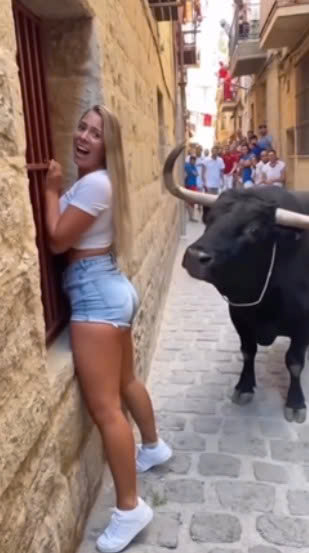
A large black bull emerged from around the corner, moving quickly and without visible restraint. Later reports suggested that a small group of animals had become separated from handlers, likely startled by the dense crowd and noise. In that moment, however, there was no time for context.
People shouted and scattered. Some rushed into doorways. Others ran down side streets. The narrow space that had felt safe moments earlier suddenly felt confining. Sofia froze.
There was nowhere obvious to run. The street was tight, the crowd chaotic. She pressed herself against the stone wall, her palms scraping its rough surface as she searched for cover. Her breathing grew shallow and fast.
The bull approached. Its size was overwhelming—muscular and powerful, its dark coat catching flashes of sunlight. Each step sent a vibration through the cobblestones. Its curved horns appeared polished and imposing.
Sofia squeezed herself into the narrow space between a doorway and an iron-barred window, hoping the confined corner might discourage the animal from coming closer. Her legs trembled uncontrollably. Tears streamed down her face as fear took hold.
For several long seconds, time seemed to slow.
The bull stopped just behind her. Its massive head hovered inches away. She felt the warmth of its breath against her back. The street grew eerily quiet. Even the distant music seemed muted by the tension.
Sofia closed her eyes.
Later, she would describe that moment as a surrender to fear. She whispered softly, barely aware of her own voice, pleading not to be harmed. She braced herself for impact.
But it never came.
Instead of charging, the bull remained still. Its ears flicked. Its breathing steadied. Its posture was tense yet restrained, as though assessing rather than reacting.
Witnesses later described the animal as alert but uncertain, appearing to process its surroundings instead of responding aggressively. The bull gently touched its nose to Sofia’s back—not forcefully, but cautiously. She sobbed, unable to move.
Onlookers watched in stunned silence. Some held their phones, unsure whether to record. Others whispered prayers. No one dared approach.
Moments passed.
Then trained animal handlers slowly entered the street from behind the bull. They moved carefully, speaking in calm tones and using specialized equipment to guide the animal. The bull lifted its head, turned slightly, and allowed itself to be directed away.
When the space cleared, Sofia’s knees gave out. Adrenaline drained from her body as relief overwhelmed her. Locals helped her to a nearby doorway, offering water while medical personnel confirmed she had no physical injuries.
Veterinarians later explained that animals, including bulls, do not react identically in every situation. In noisy, unfamiliar environments, confusion can replace aggression. Experts described the bull’s behavior as consistent with a “pause and assess” response, where an animal hesitates rather than charging immediately.
They emphasized, however, that such outcomes should never be expected. Bulls remain powerful and unpredictable, and strict safety measures are essential whenever animals are involved in public events.
The incident quickly spread across social media and news outlets. Conversations arose about festival safety, animal welfare, and organizer responsibility. Local authorities announced reviews of crowd management procedures.
For Sofia, the experience left a lasting impression.
In interviews, she spoke openly about the fear she felt and the profound awareness that followed. Standing so close to an animal capable of immense strength changed her perspective.
“I will never forget the warmth of its breath,” she said. “It was terrifying—but it reminded me how fragile life can be.”
She returned home reflective, grateful, and more conscious of the importance of caution in unfamiliar settings.
What began as a joyful cultural exploration became a story of survival and perspective. For Sofia, that narrow Andalusian street will always represent a moment suspended between danger and mercy—a reminder that powerful experiences often arrive without warning, and that respect, humility, and awareness are essential wherever we travel.