When thirteen-year-old Angelina Jordan stepped onto the stage of America’s Got Talent: The Champions, the first thing that caught everyone’s attention had nothing to do with music. It was her bare feet. She stood quietly under the bright lights, small and almost fragile in appearance, her posture calm and unassuming. Before singing a single note, she gently explained that performing barefoot was her personal tradition, something that helped her feel grounded and connected. The explanation was simple, but it immediately set her apart.
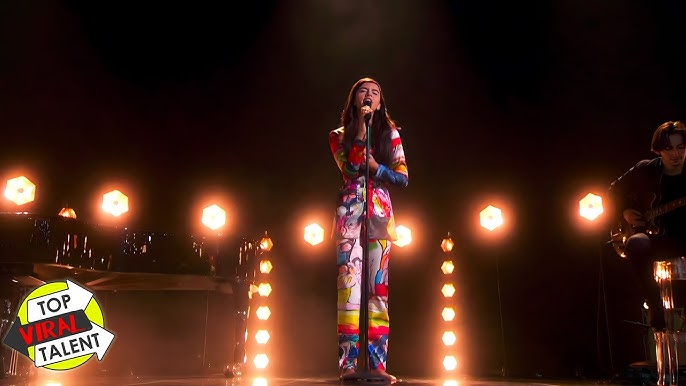
Then came her song choice. Angelina announced she would perform “Bohemian Rhapsody,” one of the most iconic and challenging songs in rock history, originally performed by the legendary band Queen. A ripple of surprise moved through the audience. The song is known for its dramatic shifts, soaring vocals, and powerful energy, and even seasoned professionals approach it with caution. Seeing such a young performer choose it created a mixture of curiosity and skepticism in the room.
What happened next erased all doubt.
Rather than attempting to imitate Freddie Mercury or replicate the original version, Angelina did something far more daring. She reimagined the song entirely. She slowed it down, transforming a stadium-filling anthem into a quiet, haunting ballad. The familiar melody remained, but the mood changed completely. From the very first note, the theater fell into silence.
Her voice was soft, almost whisper-like, yet astonishingly controlled. Each lyric was delivered with care, shaped by emotion that felt far beyond her thirteen years. There was no rush, no unnecessary embellishment. She allowed the song to breathe, letting every phrase linger in the air. It felt less like a performance and more like a story being gently told.
The judges, all veterans who had seen thousands of auditions, were visibly stunned. Their expressions shifted from polite interest to complete focus. Eyes widened. Movements stilled. It was as if the room itself had leaned forward to listen. Angelina’s interpretation stripped the song down to its emotional core, revealing a vulnerability that few versions had ever captured.
As the performance continued, the atmosphere grew heavier with feeling. The audience, initially quiet, began to react in real time. Soft cheers broke out between lines. Applause started before the song had even ended, something rarely seen in such a controlled environment. People seemed unable to hold back their admiration.
Angelina remained completely composed. Barefoot and steady, she stood at the center of the stage, her voice unwavering. When she reached the final note, she held it with precision and restraint, allowing it to fade naturally rather than forcing a dramatic ending. The moment the sound disappeared, the theater exploded.
The audience rose to their feet in a powerful standing ovation. Applause echoed from every corner of the room. Cheers filled the space. It was no longer just appreciation; it was recognition. Everyone understood they had witnessed something truly special.
Then came the moment that sealed it.
Judge Heidi Klum didn’t hesitate. As the applause continued, she stood up and slammed the Golden Buzzer. Gold confetti poured down from above, surrounding Angelina as the crowd erupted once more. The barefoot teenager looked momentarily stunned, her hands covering her face as the realization set in. She had just been sent straight through to the finals.
The reaction extended far beyond the theater. Clips of the performance quickly spread across social media, drawing millions of views from around the world. Fans praised not only her voice, but her courage to reinterpret such a legendary song in a completely new way. Even Queen’s official channels acknowledged her performance, expressing admiration for her unique take on “Bohemian Rhapsody.”
Many singers talk about wanting to “make a song their own.” Few actually succeed, especially when the song carries as much history and emotional weight as this one. Angelina didn’t overpower the song or rely on technical tricks. Instead, she approached it with respect, creativity, and honesty. She trusted her instincts and delivered something deeply personal.
What made the moment even more powerful was the contrast. There were no elaborate costumes, no dramatic staging, no backup performers. Just a young girl, standing barefoot on one of the biggest stages in the world, using nothing but her voice and her interpretation. The simplicity made the impact even stronger.
Angelina’s performance served as a reminder that true artistry has nothing to do with age. It comes from understanding emotion, from taking risks, and from having the confidence to be different. In a competition filled with extraordinary talent, her audition stood out not because it was loud or flashy, but because it was genuine.
One girl. One stage. No shoes. And a version of “Bohemian Rhapsody” that audiences will replay and remember for years to come.