I never expected that an ordinary Thursday evening in my quiet suburban kitchen would unravel a history I had spent decades trying to bury.
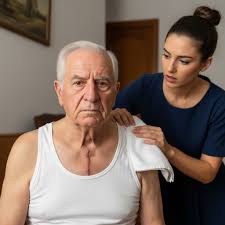
Mark was away on a five-day training trip in Seattle, and I was home alone with his father, Thomas Reynolds. Since a spinal stroke eighteen months earlier had left him paralyzed from the chest down, our evenings followed a predictable rhythm. A visiting nurse handled mornings, but after dinner the responsibility fell to me—medications, repositioning, and sometimes bathing, though that task was usually left to professionals.
I had built a life defined by routine and calm: marriage, motherhood, neatly folded laundry, school pickups, and backyard barbecues. On the surface, everything about me suggested stability. My husband understood my anxieties and quiet habits without pressing for explanations. I was grateful for that. Silence had always been my shield. It preserved our peace, even if it cost me small, unspoken pieces of myself.
Thomas, or Tom as everyone called him, had once been a retired firefighter—disciplined, strong, dependable. Now he relied on others for even the most basic needs. He accepted help with reluctant humor, masking frustration with dry one-liners.
That night, just as I cleared the dishes, my phone rang. The nurse’s car had broken down.
“I’ll try to find someone else,” she said apologetically.
“It’s okay,” I replied, forcing steadiness into my voice. “We’ll manage tonight.”
Tom gave a faint chuckle from the living room. “Guess you’re getting promoted, Hannah.”
I smiled thinly and gathered towels, soap, gloves—anything to focus on the mechanics rather than the vulnerability of the task ahead. My pulse raced for reasons I didn’t fully understand.
“I’ll explain everything as I go,” I told him gently, wheeling him toward the bathroom. “So you’ll know what I’m doing.”
“Appreciate it,” he said.
I talked too much. About Mark’s flight. About a funny story from our son’s school. About anything except the tension building inside me.
Then I unbuttoned his shirt.
At first, I saw only age and fragility. But as fabric fell away, my breath caught. Near his collarbone was a thin scar. Then another. And more—parallel lines along his ribs, clusters of healed marks that were too deliberate to be accidental.
The room tilted.
These were not surgical scars. Not random injuries. They were patterns. Controlled damage. Methods designed to leave little trace while inflicting lasting harm.
My vision blurred. My lungs felt hollow.
“Hannah?” Tom’s voice reached me through a rushing sound in my ears. “You okay?”
Darkness pressed in. For a split second, I was no longer in a tiled suburban bathroom. I was twenty years old again, trapped in a foreign detention room with concrete walls and no windows. I remembered learning that silence could be enforced without witnesses, without headlines, without legal recourse.
When I came to, I was lying on the bathroom floor. A folded towel cushioned my head. Steam fogged the mirror. Tom’s eyes hovered above me—concerned, but not confused.
“You saw them,” he said quietly.
My throat tightened. “I… what?”
“The scars.”
The secret I had carried for over twenty years suddenly felt fragile, like paper exposed to rain. I tried to assemble a denial, but it crumbled before it formed.
“I pretended they weren’t there,” he continued. “It was easier that way.”
“Those aren’t from a hospital,” I whispered.
“No,” he said.
He stared at the floor as he spoke, voice steady but heavy. Years ago, he had worked overseas under government contracts that left no official record. He had witnessed interrogations, environments where accountability was blurred. He insisted he had never personally inflicted harm, but he had been present. He had heard things. Seen things. Enough to carry regret like a shadow.
My chest tightened.
I told him my story—carefully, without graphic detail. As a college student studying abroad, I had attended a protest in the wrong place at the wrong time. I had been detained without formal charges. There had been no lawyer, no media attention. Only isolation, intimidation, and calculated pain meant to silence.
Tom’s face drained of color.
“I’ve hated myself for twenty years,” he said. “I thought I could compartmentalize it. Pretend that chapter never happened.”
“I have scars too,” I replied softly.
His whisper came almost as a confession. “I know.”
In that moment, two people who had lived on opposite sides of a locked system found themselves bound by the same unspoken weight.
“Mark can’t know,” I said quickly, panic rising. My husband saw his father as a hero, a steady presence who rebuilt his life after tragedy. He saw me as resilient but ordinary. I wasn’t ready to fracture those images.
“He won’t,” Tom assured me. “I’ve let him believe in a version of me that’s easier to live with.”
We finished the bath in silence. The air felt different—denser, charged with understanding neither of us had expected.
Later that night, Tom asked me to retrieve a box from his study. Inside was a thick envelope. Dates. Locations. Logs. Notes. Documentation he had quietly kept all these years.
“To someone who survived,” he said, placing it in my trembling hands.
I sifted through the papers carefully. They were not sensational. They were clinical. Yet together they confirmed something profound: what I had endured had not been imagined, exaggerated, or misplaced. It had been real.
Mark returned three days later, tired but cheerful, unaware that the ground beneath our family had subtly shifted. Tom watched him with complicated eyes—regret still present, but now accompanied by a kind of relief.
Secrets can protect us. They can preserve relationships and shield fragile narratives. But they can also confine us, turning survival into silent imprisonment.
Holding that envelope, I understood something I had avoided for years. Enduring was only the first step. Living fully required choice—what to confront, what to forgive, what to disclose, and what to hold privately.
The past does not vanish simply because we refuse to name it. It lingers quietly, folded into daily life, waiting for a moment when recognition forces it into the light.
For years, my Hidden Scars Secret had been mine alone. That night in the bathroom did not erase the pain of the past, nor did it solve the moral weight Tom carried. But it transformed isolation into shared understanding.
Some truths must remain between those who truly grasp their meaning. Yet acknowledging their weight can be the first step toward reclaiming your own narrative.
I once believed survival meant silence. Now I understand that freedom begins when we dare to face what we have endured—and decide, with intention and courage, how it will shape the rest of our lives.