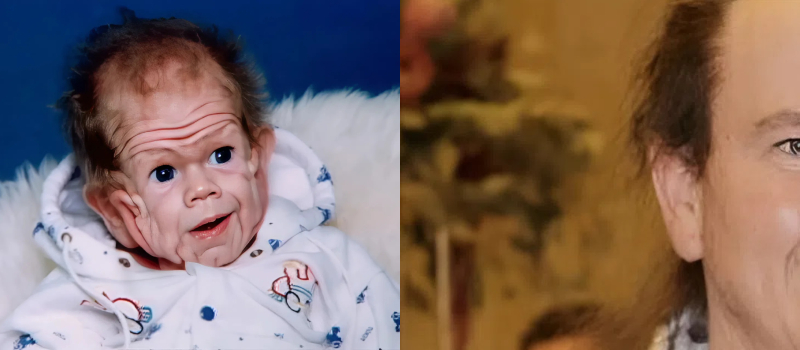
When Tomm Tennent was born, the delivery room fell into a silence so heavy it felt as though even the monitors paused in disbelief. Doctors exchanged uncertain glances. No one spoke right away. His tiny body was covered in folds of loose skin that seemed far too large for him, as if he had been wrapped in layers meant for someone much older. Debbie Tennent trembled as they placed her newborn son on her chest. Fear and love collided in her heart. She gently kissed his wrinkled forehead and whispered the only truth she knew in that moment: “You’re mine, and I’m not letting you go.”
Beside her, Geoff Tennent gripped the bedrail, trying to steady himself. He thought back to the long nights he and Debbie had spent staring at unclear ultrasound images that puzzled even experienced specialists. The shapes had looked unusual, but no one could give them answers. “What’s meant to be is meant to be,” Geoff had said then, trying to sound brave. Now, looking at his son, he wondered if those words had been wishful thinking. But when Tomm let out a small, fragile cry—proof of life and strength—something inside Geoff softened. Whatever lay ahead, this was their child.
Tomm spent the first months of his life in the hospital, surrounded by doctors, researchers, and curious medical professionals. Specialists traveled from different universities to examine him. They measured his skin, studied its elasticity, and spoke in quiet, clinical tones near his crib. Debbie struggled with those moments. To her, he was not a medical mystery. He was her baby. Still, she listened carefully to every explanation, searching for hope.
One day, Dr. Andrew Ramsden crouched beside her and spoke honestly. “We don’t understand everything yet,” he admitted, “but I believe he may grow into his skin. We just need time.” That simple statement became Debbie’s anchor.
Soon after, doctors discovered that Tomm had unusually high levels of hyaluronic acid in his body—the same substance responsible for skin elasticity and found in high amounts in Shar Pei puppies. When the doctor explained the comparison, Debbie blinked in disbelief. Puppies? Wrinkles? It sounded strange, but when she saw the diagrams, the similarities were undeniable. The doctors believed that as Tomm grew, those levels might decrease, allowing his skin to tighten naturally.
And slowly, that’s exactly what happened.
As months turned into years, Tomm’s appearance began to change. The deep folds softened. His features became more defined. He laughed easily, explored fearlessly, and ran barefoot through the backyard like any other child. At home, he was simply Tomm—curious, energetic, and full of personality.
School, however, introduced new challenges.
On his first day in class, whispers followed him. Some children stared openly. Others struggled to hide their reactions. Debbie noticed every glance and every hushed comment. It took everything in her not to pull him close and shield him from the world. But Tomm surprised her. Over time, he learned to navigate those reactions with resilience. He made friends who valued his humor and kindness. When teased, he often shrugged it off with a confidence beyond his years.
“Mom,” he once said with a grin, “people stare because I look interesting. That’s better than being boring.”
Debbie hugged him tightly, fighting back tears. His strength humbled her.
Though his skin improved significantly, faint differences remained. His body healed in its own way. Certain features carried subtle reminders of his early condition. But Tomm embraced who he was. As he entered his teenage years, he developed a quiet charisma that often made people forget their first impressions.
Then one afternoon, something unexpected happened.
Tomm came home from school unusually quiet. Debbie waited, sensing something important. Finally, he looked up and said, “Mom… I met someone who looks like me.”
Her heart skipped. He explained that a new student, Joel, had joined the school. Joel also had unusually loose skin—not identical to Tomm’s early condition, but strikingly similar. When they spoke, Joel mentioned that doctors had once described his condition as a hyaluronic imbalance.
The same phrase Tomm had grown up hearing.
Debbie felt a chill. For years, specialists had suggested Tomm’s condition was unique. Now there was another child with similar traits. Within days, Joel’s mother contacted Debbie. She sounded relieved and emotional. “I’ve been searching for families like ours,” she said. “And I think there may be more.”
The possibility was overwhelming.
As weeks passed, more stories surfaced. Families from different countries began sharing similar experiences—children born with unusually loose skin and elevated hyaluronic acid levels that gradually normalized with age. Researchers started examining the cases more closely.
One evening, Dr. Ramsden visited the Tennent home with new findings. He looked both excited and cautious. “We’ve identified a rare genetic mutation shared among these children,” he explained. “It’s not random. There’s a connection.”
Tomm listened carefully. “What kind of connection?” he asked.
The doctor paused before answering. “Preliminary research suggests a shared ancestral origin. A genetic line that appears across different continents. It was thought to have disappeared centuries ago.”
The room fell silent.
The idea that Tomm’s condition might link him to a larger, forgotten genetic history was astonishing. What once seemed like an isolated medical anomaly now appeared to be part of something far bigger—a rare inherited trait that had quietly resurfaced across generations.
For Tomm, the discovery changed everything. He was no longer the “one-of-a-kind” mystery doctors had struggled to define. He was part of a community. A lineage. A scientific breakthrough in progress.
As an adult, Tomm carries himself with quiet confidence. His appearance bears only faint traces of his early condition. Those who meet him often see a thoughtful, grounded man before they learn about his extraordinary beginning. He speaks openly about his journey, understanding that his story offers hope to families navigating rare medical diagnoses.
Looking back, Debbie often remembers that silent delivery room and the fear that once overwhelmed her. What she couldn’t see then was the future unfolding—a future where her son would grow, thrive, and help reshape medical understanding.
Tomm’s life challenged doctors for two decades. But more importantly, it redefined what strength looks like. What once caused confusion and uncertainty became a pathway to discovery and connection.
And today, when he smiles, there is no trace of the fear that once filled that hospital room—only resilience, gratitude, and the quiet reminder that sometimes, the rarest beginnings lead to the most remarkable futures.