The son of a wealthy businessman stopped walking overnight. There was no accident, no visible injury, and no clear medical explanation. One day he was running through the halls of his family’s grand estate, laughing beneath crystal chandeliers. The next, he refused to place a single foot on the floor.
Doctors searched for answers. Specialists were consulted. Endless tests were performed. The conclusions were frustratingly vague. Some suggested psychological trauma. Others mentioned a mental block, perhaps stress too heavy for a seven-year-old to carry. None could offer proof. None could offer certainty.
Inside the Valdes mansion, the silence became suffocating. In the center of the expansive living room, beneath an enormous chandelier, little Leo sat motionless in a wheelchair that had quickly become a symbol of confusion and helplessness. His once bright smile had faded. His playful energy was gone.
Paulina, his stepmother, had her own theory.
“He’s manipulating everyone,” she would say coldly. “He just wants attention.”
Her words echoed through the marble halls with unsettling confidence. According to her, Leo’s inability to walk was nothing more than an act. A performance designed to command sympathy.
Javier, Leo’s father and a respected businessman, was torn. He was exhausted from months of medical appointments, sleepless nights, and mounting uncertainty. He watched his son sit there, small and pale in that oversized chair, and wondered where the lively child he knew had disappeared.
Three months passed. Still no diagnosis. Still no progress.
In the background, nearly invisible to the family, was Carmen, the housekeeper. She moved quietly through the house, cleaning and observing. Few noticed her presence. Fewer still listened to her voice. But Carmen noticed details others overlooked.
One afternoon, while dusting near Leo’s chair, she saw something unsettling.
Despite the mansion’s strong air conditioning, Leo was sweating. Tiny beads of perspiration formed along his forehead. His hands were tense. And his right foot, hidden beneath a thick wool sock carefully pulled up to his calf, trembled slightly.
It was a small tremor. Subtle. Rhythmic. But it was there.
When Paulina sharply instructed Leo to stand, his face drained of color. His fingers gripped the armrests. Fear was written clearly in his expression.
In that moment, Carmen understood.
This was not a tantrum. It was pain.
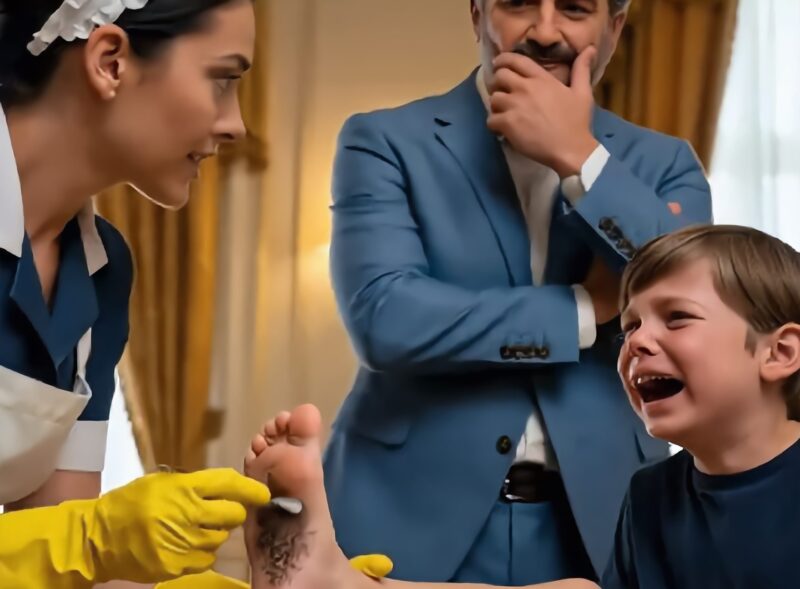
Taking advantage of Javier’s hesitation, Carmen knelt gently beside the wheelchair. She spoke softly to Leo, her voice steady and reassuring. With careful hands, she began to roll down the thick wool sock.
Leo cried out.
The sound froze the room.
Wrapped tightly around his ankle was a compression bandage wound far too tightly for comfort. His skin underneath was red, almost purplish. Hidden inside the sock were small metallic beads pressing firmly into his foot, creating continuous pressure.
His circulation was being restricted.
“It’s therapeutic,” Paulina insisted quickly, her tone defensive.
But as Carmen loosened the bandage, the truth became visible. Leo’s toes twitched. Then his foot moved slightly. It was as though life was returning to it.
“Daddy… it hurts when she makes me stand,” Leo whispered through tears.
The words landed heavily in the silent room.
Javier felt the weight of realization settle over him. His son had not been pretending. He had been frightened. He had been in pain. The very act of forcing him to stand had been causing physical suffering.
With the bandage removed, Carmen supported Leo carefully under his arms. His father knelt in front of him, eyes filled with a mixture of shock and regret.
“Try, son,” Javier said gently.
Leo lowered his right foot to the ground. It trembled at first. His body wobbled slightly. But he did not collapse.
He stood.
One small step followed. Then another.
He could walk.
The wheelchair that had dominated the living room for months suddenly looked unnecessary, almost absurd. The heavy silence that once filled the mansion shifted into something else entirely—clarity.
The truth had not come from renowned doctors or expensive specialists. It had not emerged from high-tech equipment or clinical theories. It had come from observation. From attentiveness. From someone willing to look closely when others looked away.
That day changed everything.
Javier faced the painful reality that trust had been misplaced. Assumptions had nearly cost his son his well-being. What had been dismissed as psychological drama was, in fact, preventable suffering.
Carmen had simply paid attention.
In a household filled with wealth, influence, and authority, the most important voice had belonged to the person least noticed. Her willingness to observe, to question, and to act with compassion revealed what everyone else had failed to see.
Leo’s recovery was not instant, nor was it effortless. His ankle required proper medical care to restore healthy circulation. But once the harmful pressure was removed, his strength gradually returned. With patience and reassurance, his confidence followed.
The mansion felt different in the weeks that followed. The air no longer carried the same tension. Leo’s laughter slowly returned to the halls. The wheelchair was moved away, no longer a symbol of mystery or doubt.
Sometimes, the answers we seek are not hidden behind complex explanations. Sometimes, they are concealed beneath something as simple as a sock.
This story serves as a reminder that children deserve to be heard, believed, and protected. It also reminds us that careful observation can be more powerful than assumption. When something feels wrong, it often is.
All it takes is one person brave enough to look closely.
Sometimes, saving a child begins with the courage to notice.