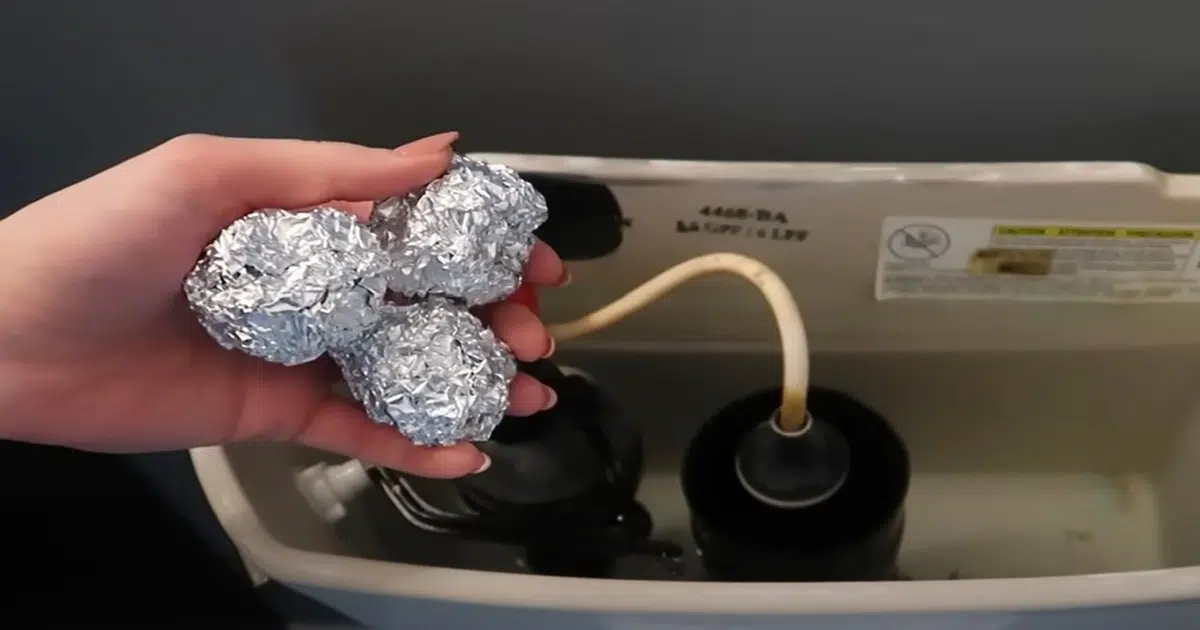
In recent years, social media has become a breeding ground for unusual household hacks, and one of the most talked-about trends involves dropping a small ball of aluminum foil into a toilet tank. If you’ve spent time browsing platforms like TikTok or YouTube, you’ve probably seen videos claiming that this simple trick can solve a surprising number of problems. According to these clips, aluminum foil can reduce toilet leaks, prevent rust, lower water bills, and even keep the toilet bowl cleaner for longer. It sounds almost magical—an inexpensive item from your kitchen suddenly transforming your bathroom maintenance routine. But as appealing as it sounds, the big question remains: does this trick actually work, or is it just another internet myth?
The truth is that many of these so-called life hacks gain popularity not because they are proven effective, but because they spread quickly through social media. A single viral video can spark thousands of people to try the same experiment in their homes. Once a few users claim that the trick “worked,” the idea spreads rapidly across online forums, home improvement groups, and comment sections. Before long, it starts to feel like common knowledge—even though there may be little or no scientific evidence behind it.
Part of the reason people believe in the aluminum foil trick is that foil itself has a reputation for being surprisingly versatile. For decades, people have used aluminum foil for a variety of household tasks. It can be crumpled into a ball to scrub burnt residue from cookware, used to sharpen scissors by cutting through several layers, or placed under an ironing board cover to reflect heat back into clothing for more efficient ironing. Because foil is metallic, reflective, and somewhat resistant to corrosion, some people assume it might have useful effects in other places around the home as well—including the toilet tank.
Once the idea started circulating online, the claims quickly multiplied. Supporters of the trick say that adding foil to a toilet tank offers several benefits. One common claim is that it saves water by occupying space in the tank, which supposedly reduces the amount of water used during each flush. Another claim suggests that the foil somehow helps prevent leaks by improving the seal of the flapper valve—the rubber component that opens and closes during flushing. Others argue that the foil prevents rust or mineral buildup in the tank and keeps the toilet bowl cleaner for longer periods of time.
While these claims may sound appealing, plumbing professionals and scientific explanations paint a very different picture. Let’s begin with the idea that foil saves water by reducing the tank’s volume. It’s true that reducing the amount of water inside a toilet tank can lower the amount used per flush. However, there are already proven methods designed specifically for that purpose. Some homeowners place a plastic bottle filled with water or sand inside the tank, while others install specially designed displacement bags. These devices work because they are solid, heavy, and remain in place, effectively reducing the amount of water that fills the tank.
Aluminum foil, on the other hand, is extremely lightweight. Even when rolled into a ball, it does not stay firmly in position. Instead, it tends to float or shift around as water moves through the tank. Because of its small mass and irregular shape, the amount of water it displaces is negligible compared to proper water-saving devices. In practical terms, it simply does not create a meaningful reduction in water usage.
Another common belief is that aluminum foil can help prevent leaks by improving the seal of the flapper valve. In reality, toilet leaks usually occur because the flapper becomes worn out, warped, or covered in mineral deposits. Over time, rubber components naturally degrade, which prevents them from forming a tight seal. Adding aluminum foil does nothing to address these underlying problems. In fact, plumbers generally advise homeowners not to place random objects inside the tank. Any loose material could potentially interfere with the moving parts of the flushing mechanism, which might create new issues rather than solving existing ones.
The claim that aluminum foil prevents rust or mineral buildup is also unsupported by science. Rust and scale form due to the mineral composition of the water, its pH level, and the exposure of metal components inside the tank. Aluminum foil does not change the chemical properties of the water. It cannot neutralize iron, stop calcium deposits from forming, or alter the mineral content of the supply. In some situations, aluminum can even react with certain cleaning products, which could cause the foil to degrade over time and create additional debris in the tank.
Some people also believe that the foil helps keep the toilet bowl cleaner for longer. The idea behind this claim is that if the tank remains free of rust or leaks, the bowl will naturally stay cleaner as well. However, since the earlier assumptions are incorrect, this final claim does not hold up either. Toilet cleanliness depends on factors such as water quality, the glaze on the ceramic surface, and how frequently the bowl is cleaned. Aluminum foil does not possess antibacterial or antimicrobial properties, meaning it cannot prevent stains, slime, or bacteria from forming.
Beyond simply being ineffective, placing aluminum foil in the toilet tank can sometimes introduce new problems. Small pieces of foil may break off and interfere with the flapper valve or other moving components. Loose objects inside the tank can also become lodged in the flushing system, potentially leading to clogs or mechanical malfunctions. Additionally, manufacturers often warn against adding foreign materials to the tank, since doing so could void product warranties if damage occurs.
Another concern is that relying on unproven hacks may create a false sense of security. If someone believes the foil has fixed a leak or prevented a plumbing issue, they may delay addressing the real problem. A small leak that goes unrepaired can waste hundreds or even thousands of gallons of water over time, increasing utility bills and potentially causing damage to plumbing components.
Professional plumbers and bathroom fixture manufacturers generally recommend sticking with proven maintenance methods. If your goal is to save water, consider upgrading to a modern low-flow or dual-flush toilet. If your toilet is leaking, replacing the flapper or adjusting the float mechanism is often a quick and inexpensive solution. Mineral buildup can be managed with appropriate descaling products or by installing a water softener if your home has particularly hard water. Regular cleaning with mild, non-abrasive products also helps keep the toilet bowl looking fresh.
Aluminum foil certainly remains a useful tool in the kitchen and for various household tasks, but placing it in the toilet tank does not deliver the impressive benefits claimed online. At best, it has little effect. At worst, it may lead to unnecessary complications or prevent homeowners from addressing genuine plumbing issues. In the end, the aluminum foil toilet tank trend appears to be just another internet curiosity—an entertaining idea that spreads quickly but lacks real evidence to support it.