Everyone in the hospital room seemed to freeze at the same moment, as if time itself had suddenly slowed to a halt. No one spoke. No one moved. The silence pressed down so heavily that it felt almost physical, and yet, at first, no one could explain why. It was only later, when the reality began to unfold, that they understood something deeply unexpected had just happened.
That day was never meant to be the day everything changed. I had been waiting for what I believed would be the most beautiful moment of my life—the birth of my child. Every detail had been prepared with care and love: the nursery was ready, tiny clothes folded neatly, and dreams of the future filled every corner of my mind. I imagined laughter, joy, and the soft cry of a newborn announcing his arrival.
But when my baby finally came into the world, the room did not fill with the sounds I had been expecting. There was no immediate cry, no shared smiles, no relief. Instead, there was silence. A deep, overwhelming silence that sent a chill through my entire body.
I looked around, confused and searching for answers. The doctors stood still, their faces unreadable. The air felt heavy, almost difficult to breathe. My heart slowed in a way that frightened me, as if it were trying to match the stillness around me. In a fragile voice, barely above a whisper, I asked the question that echoed in my mind: “Why is everyone so quiet? Did something happen?”
The doctor avoided my gaze, focusing instead on the monitor. Beside him, a nurse suddenly began to cry softly. That quiet sound—just a single sob—etched itself into my memory in a way that words never could. It was in that moment that I realized something was not right.
I waited desperately to hear my baby’s cry. That small, powerful sound that confirms life, breath, presence. But it never came. All I could hear was the steady hum of machines and that unbearable silence. Someone tried to guide me away, but I refused to move. I needed to understand. I needed someone to tell me what was happening.
When the doctor finally approached me, I didn’t need him to speak. I saw everything in his eyes—a mixture of helplessness and controlled fear. Then he said a few simple words, quiet but final, and my world shifted in an instant. Nothing would ever be the same again.
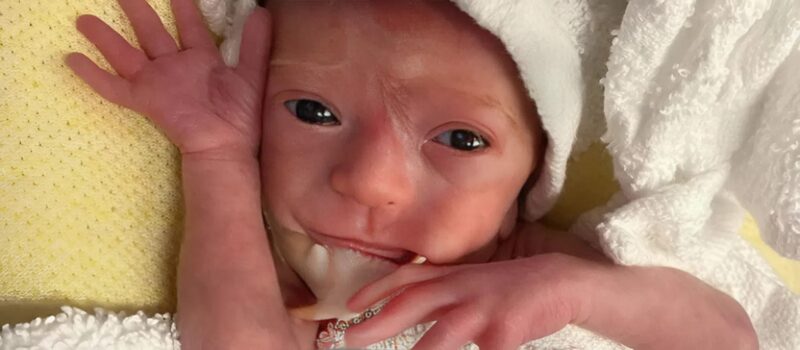
I wasn’t able to hold my baby right away. I only caught a brief glimpse of his tiny, fragile body before he was taken away down the corridor. His skin looked so delicate that I could see faint veins beneath it. As he disappeared from view, it felt as though my heart was being carried away with him. I whispered, barely able to breathe, “Please… don’t take him from me again.”
That night, sleep was impossible. I lay awake listening to the cries of other newborns and the soft, comforting voices of their mothers. Each sound reminded me of what I was missing. It was a quiet kind of pain, one that settled deep within me and refused to leave.
The next day, I was finally allowed to see him again. He was inside an incubator, surrounded by wires, sensors, and a small mask that helped him breathe. And yet, despite everything, his heart was still beating. I placed my finger gently near his hand, and to my surprise, he grasped it weakly. Tears filled my eyes.
“He can feel you,” the nurse said softly. “Keep talking to him.”
So I did. Every day, I spoke to him as if he could hear every word. I told him about our home, about his father Julien, about the ocean we would one day visit together. The doctors remained cautious, reminding me that the first weeks would be critical.
There were moments that tested every ounce of strength I had. Two infections, a brief cardiac arrest, and countless hours of uncertainty. Yet somehow, he kept going. Every breath, every heartbeat felt like a miracle unfolding in real time.
Then one morning, something changed. The incubator was open. The machines were no longer needed in the same way. For the first time, I was able to hold him without barriers. His warm body rested against my chest, his heart beating steadily against mine. It was a moment I had waited for with every part of my being.
Weeks later, he gave me a small, fragile smile. It was simple, almost fleeting, but it erased months of fear and doubt in an instant. That smile became a symbol of hope, a reminder that even in the most uncertain circumstances, life can still move forward.
After three months, we were finally able to return home. Life slowly began to take on a new rhythm, one shaped by patience, care, and quiet victories. Today, my son is five years old. He runs through the garden, laughs freely, and calls out to me with a voice full of life: “Look, Mom!”
Each year, we return to the hospital to visit the people who were part of his journey. The nurses call him “the miracle of Lyon.” He brings them drawings of lions and rockets, symbols of strength and dreams. And in many ways, he truly is like a lion—strong, resilient, and full of quiet courage.
What my son has taught me is something I carry with me every day. Courage does not always appear in grand gestures; sometimes, it fits within the smallest hand. Love does not wait for perfect conditions; it comes first, guiding everything that follows. And the battles we fight in silence can shape us in ways we never expected.
Most importantly, I have learned that silence itself is not always empty. Sometimes, it holds fear, uncertainty, and unanswered questions. But other times, it carries peace, understanding, and a connection that words cannot fully express. And in that silence, I found not just strength, but a new way to see the world.