The city had finally exhaled into that rare, heavy quiet that only comes after midnight, when neon lights dim and the noise of the day fades into distant echoes. Maya stepped out of the gym with slow, deliberate movements, the kind that come from someone who knows exactly how far their body can be pushed—and how much it has already endured. Her muscles carried a deep, steady burn, not from weakness but from discipline, the lingering result of hours spent training beyond comfort.
It wasn’t the kind of exhaustion that breaks a person. It was something earned, something controlled. She walked through the cool night air, letting the chill settle into her skin, calming her breathing and clearing her thoughts. To anyone passing by, she looked like just another tired woman heading home after a long shift—someone easy to overlook, someone unremarkable. That anonymity was intentional.
Her destination never changed. At the end of long nights, she always found her way to a small diner tucked between quiet buildings—the Silver Spoon. It wasn’t impressive. The sign flickered, the menu was simple, and the space felt worn with time. But for Maya, it was the one place where she didn’t have to be anyone else. She could simply exist without expectation.
Inside, the air carried the familiar scent of cooking oil and warm tea. The hum of the old refrigerator filled the silence like a steady heartbeat. Arthur, the owner, gave her a quiet nod as she slid into her usual booth. He didn’t ask questions. He didn’t interrupt her silence. He simply prepared her meal the way he always did.
Maya leaned back, letting the worn seat support her. She reached into her pocket and felt the soft, frayed fabric of her old hand wraps—the same ones she had worn through countless matches, through victories and losses alike. They were a reminder of a life she had stepped away from, a world that had demanded everything from her.
Then the calm shattered.
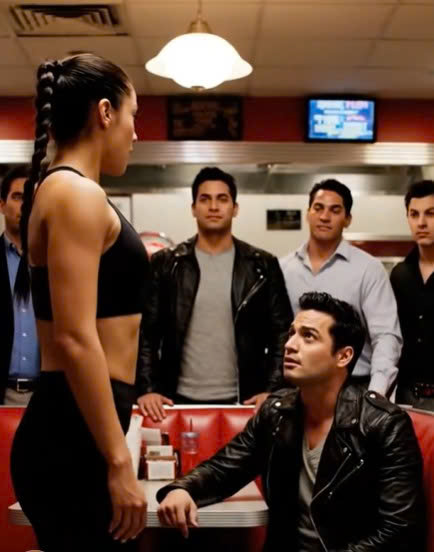
The diner door swung open with a force that broke the quiet atmosphere. A man named Vince walked in, followed by three others. Their presence changed the energy instantly. Conversations stopped. Movements slowed. Everyone in the room seemed to retreat into themselves.
Vince didn’t come for food. He came to be seen.
He walked directly toward Maya’s booth, ignoring the empty seats around him. His expression carried a confidence built on intimidation.
“You’re in my seat,” he said, his voice low but sharp.
Maya didn’t look up right away. She remained focused on her plate as it was placed in front of her. “There are plenty of seats,” she replied calmly. “You can take any of them.”
Vince’s smile tightened. “That’s not how this works,” he said. “This spot is mine.”
Then, in a slow, deliberate motion, he lifted his boot and pressed it down onto her meal, crushing it against the plate. The act wasn’t about food—it was about control, about sending a message to everyone watching.
The room went silent again, heavier this time.
Maya looked down at the ruined meal. She took a breath, steady and controlled. When she finally raised her eyes, they were calm—too calm.
“You didn’t need to do that,” she said quietly.
Vince leaned closer, expecting fear, expecting a reaction that would confirm his authority. But what he saw instead unsettled him.
When he reached toward her, everything changed in an instant.
The movement was quick, precise, almost invisible. In seconds, the situation reversed. Vince found himself on the floor, his balance gone before he even understood what had happened. His companions moved to react, but they were met with the same controlled efficiency.
Maya didn’t act out of anger. Her movements were measured, practiced, and restrained. Within moments, the threat had been neutralized without chaos, without unnecessary force.
The room remained still, but the silence now carried a different meaning.
Maya stepped back, her breathing steady. “You should leave,” she said simply.
There was no argument this time. Vince and the others hurried out, their confidence gone, replaced by uncertainty.
When the door closed behind them, the tension slowly began to fade.
Arthur stood behind the counter, his expression filled with concern rather than relief. “That won’t be the end of it,” he said quietly. “People like that don’t let things go easily.”
Maya walked over to him, her demeanor softening. She reached into her pocket again, this time pulling out a small envelope and a key.
“He won’t be coming back,” she said.
Arthur looked confused as she placed the items on the counter. She explained calmly that she had been quietly supporting the diner for years, ensuring it stayed open, and had recently secured its future completely.
The realization took time to settle. Arthur’s eyes filled with emotion as he understood what she had done—not out of obligation, but out of care.
“Why?” he asked softly.
Maya looked at him, her expression thoughtful. “Because you treated me like I mattered when no one else did,” she said. “Before anything else, before anyone knew who I was.”
The diner, simple as it was, had given her something she couldn’t find anywhere else—a sense of belonging.
As she stepped outside, the first light of morning began to appear on the horizon. The city was starting to wake again, slowly, quietly.
Maya walked away from the diner, leaving behind the identity that the world recognized and carrying only the part of herself that truly mattered.
For her, the greatest victories were no longer found in arenas or under bright lights. They were found in quiet moments—in protecting something meaningful, in preserving a place that felt like home.