The envelope was made of elegant cream paper—the kind Garrett always said was too expensive for us. But this wasn’t a bill, a reminder, or another notice about how hard my life had become. It was a wedding invitation.
Garrett was marrying Tessa—the woman he left me for four years earlier—and he wanted me there, front and center, to witness the next chapter of his life. Inside was a handwritten note in that perfectly neat script he once used to write love letters to me… before signing the divorce papers.
“No hard feelings. The kids should see we’ve both moved on. Be happy.”
No hard feelings. Not for the betrayal. Not for the divorce. Not for everything he took, leaving me with $700 a month, a broken life, and shared weekends with my own children.
Then I saw the date—June 15.
Our wedding anniversary.
He had chosen the exact day we once said “I do” to marry someone else.
That was the moment I decided I would go. But not the way he expected—not broken, not defeated. I would show up so he could see, with his own eyes, exactly what he had lost.
And I had eighteen months of secrets to prepare.
My name is Rebecca Hartwell. This is how I showed up at my ex-husband’s wedding with our twins and a man by my side Garrett never saw coming—and how the life he built on lies came crashing down.
Four years earlier, Garrett came home earlier than expected. I was in the kitchen cooking spaghetti, while our four-year-old twins, Evan and Emma, played in the living room, stacking blocks.
He stood in the doorway, loosened his tie, and said the words that changed everything.
“We need to talk.”
Then, without hesitation: “I want a divorce.”
The spatula slipped from my hand, sauce splattering across the floor.
“Why?” I asked.
“I met someone. Someone who understands me. Someone who shares my ambitions.”
Someone younger. More polished. Not worn down by raising young children.
It was Tessa—my friend. The woman who stood beside me on my wedding day.
The divorce was ruthless. Garrett’s lawyer was experienced and relentless. Mine was new and affordable—that’s all I could manage. Garrett kept the house, the savings, the retirement accounts—everything. On paper, I walked away with almost nothing. I was a stay-at-home mom, and that was used against me: no career, no leverage, no voice.
The judge barely looked at me.
I was left with scraps.
The next four years were a constant struggle. Two jobs. Little sleep. Quietly relying on food assistance so my children wouldn’t worry. Modest birthdays. Shoes repaired instead of replaced. And Patricia, Garrett’s mother, never missed a chance to remind me that if I had “taken better care of myself,” her son might not have left.
So when the invitation landed on my kitchen counter, it felt like another insult. Another calculated move.
At first, I was furious.
Then my computer buzzed.
Julian.
The man I met eighteen months earlier—the day I accidentally spilled coffee on his laptop. He didn’t get angry. He laughed. Only later did I learn about his quiet wealth. Since then, he had stayed by my side, never flashy, never controlling, protecting what we had from Garrett’s influence.
That afternoon, a courier knocked on my door.
Inside the package were documents—hidden accounts, undisclosed assets, undeniable proof that Garrett had lied throughout the divorce.
At the bottom was a note from his former business partner:
“Enough to reopen the case.”
And another message, from Julian:
“You don’t have to hide anymore.”
For the first time in years, hope broke through.
We reopened the case. And I made my decision: I would go to the wedding. But this time, I wouldn’t be alone.
The twins met Julian just days before. I was nervous, afraid they might believe the stories Garrett had told about me. But Julian never pretended to be anything he wasn’t. His patience and kindness spoke louder than words.
That night, Emma whispered, “You’re really smiling again.”
Even Evan noticed.
As the wedding approached, Garrett started calling more often, sending messages, trying to control the narrative. But I already knew what I was going to do.
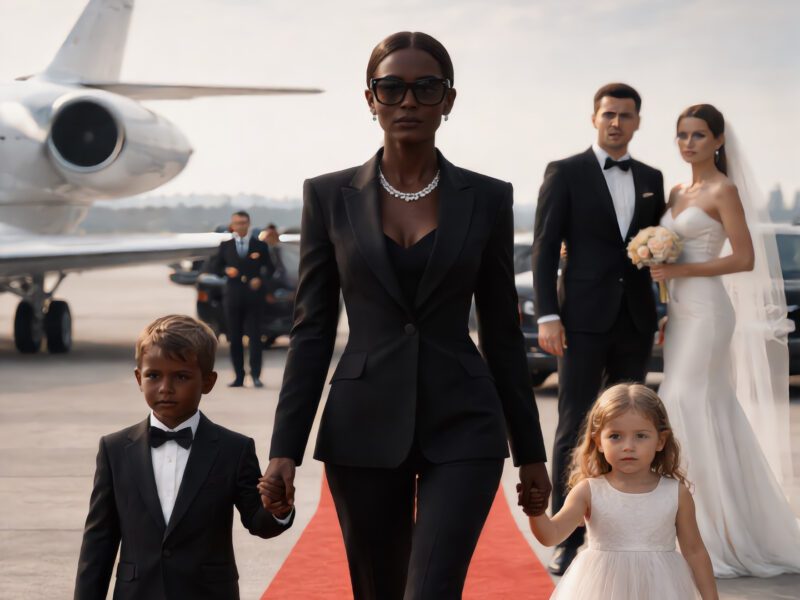
On the day of the wedding, I wore a deep green dress—the one he once criticized. Julian stood beside me in a tailored dark suit, calm and confident. The children looked perfect.
We arrived at a private estate, the kind Garrett always claimed was beyond our reach.
When we entered, the room fell silent. Conversations faded into whispers, then into stunned silence. Garrett’s face went pale, then tightened with anger.
The ceremony continued, but control had already slipped from his hands.
During the reception dinner, the truth came out. His former associate revealed everything—every hidden account, every lie, every deception.
Within minutes, the illusion shattered. Tessa walked out, her father close behind. Guests followed. The celebration unraveled in real time.
Garrett stood alone, exposed.
He caught up with me outside.
“What did you do?” he demanded.
“I told the truth,” I replied.
There was a long, heavy silence.
“I made a mistake…”
Once, those words would have meant everything.
Now, they meant nothing.
“That’s yours to live with,” I said quietly.
Three months later, the case was closed. Justice was served. Garrett lost everything he had built on deception.
And me?
I was finally free.
Julian stood beside me—not as a savior, but as a true partner. My children’s laughter filled our home again. Sunlight poured into my kitchen, no longer overshadowed by fear or regret.
And I realized something important.
The real victory isn’t revenge.
It’s no longer needing it.
I had my life back. And for the first time in years, I felt whole.